Glass Weight Calculator (kg, lbs & sq ft)
Introduction
A glass weight calculator is a specialized digital tool engineered to determine the exact mass of glass panels. It computes weight by processing the physical dimensions, material thickness, geometric shape, and the specific density of the chosen glass type. This tool eliminates manual math errors and provides instant figures for project planning.
Calculating glass weight is a mandatory step for structural safety and logistical planning. Knowing the exact load prevents the overloading of architectural frames, ensures hinges and hardware are rated correctly, and protects workers during transport and installation. Overloading structural supports with heavy glass leads to catastrophic mechanical failures and safety hazards.
Multiple industries rely on precise glass weight calculations daily. Architecture firms use it for facade load bearing. Construction teams require it for crane rigging and lifting limits. Interior designers need it for mounting wall mirrors and glass shelving. Automotive manufacturers and custom aquarium builders depend on it to verify structural integrity under pressure.
The core formula driving these calculations is straightforward. The calculator first determines the total surface area based on the shape. It then multiplies the area by the thickness to find the volume. Finally, it multiplies the volume by the specific density of the glass to output the total weight.
Glass Weight Calculator Overview
The interactive calculator provided at the top of this page delivers instant, precise weight data. Understanding how the inputs process your data ensures you get the most accurate output for your engineering or design needs.
Inputs
The calculator requires specific data points to generate an accurate weight reading. Each input directly affects the volume or density multiplier in the background equation.
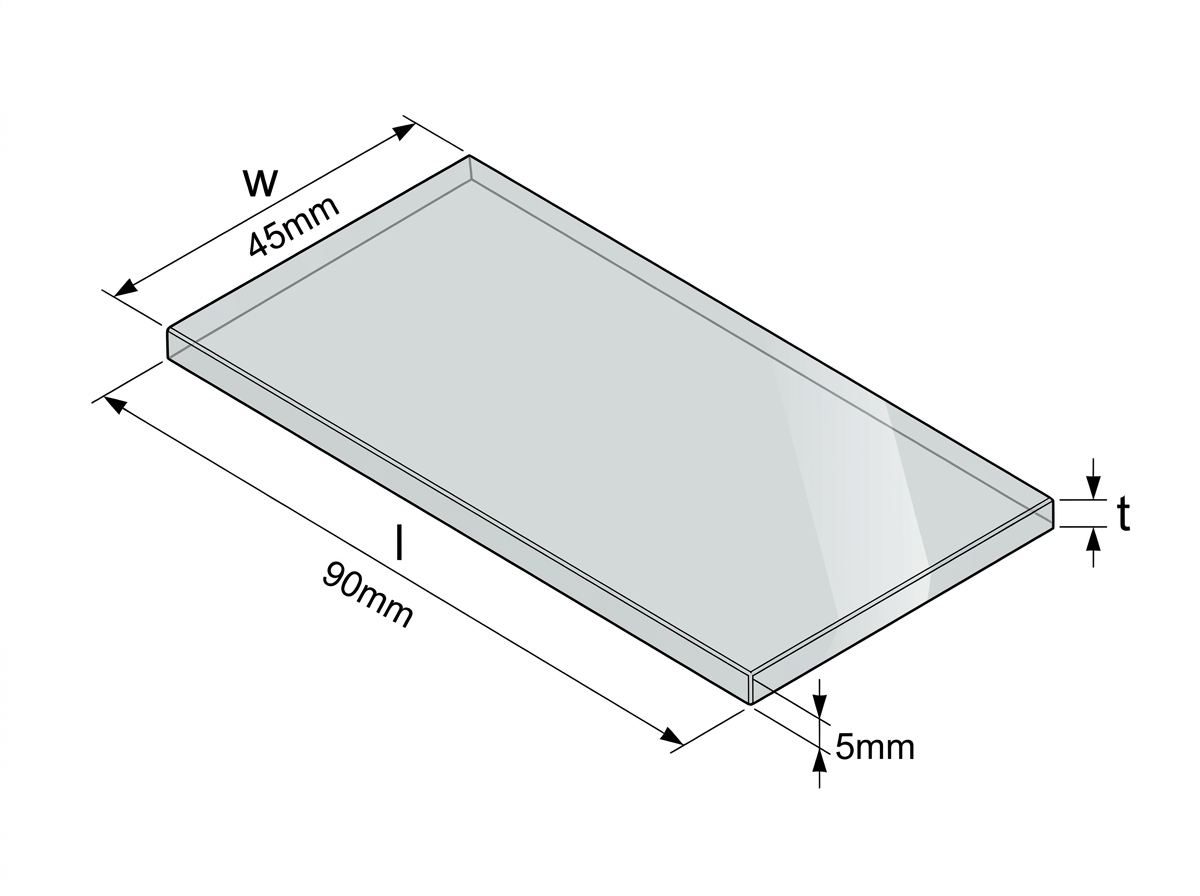
- Glass Length: The longest measurement of a rectangular or square panel, dictating the primary surface area.
- Glass Width: The secondary dimension for flat panels, multiplied against length to establish the 2D footprint.
- Thickness: The depth of the material. This transforms the 2D area into a 3D volume. Standard thicknesses range from 3mm up to 19mm.
- Glass Type: Different chemical compositions alter the density. Selecting the correct type ensures the mass multiplier matches the physical material.
- Unit Selection: The system allows seamless switching between metric (millimeters, centimeters, meters) and imperial (inches, feet) inputs.
Output
Once the dimensions are processed, the calculator generates four distinct data points to assist with your structural planning and purchasing.
- Weight in kg: The standard metric measurement of mass, essential for international shipping and modern architectural load calculations.
- Weight in lbs: The standard imperial measurement of mass, heavily used in United States construction and logistics.
- Area: The total 2D surface space of one side of the panel, crucial for applying coatings, films, or calculating wind loads.
- Volume: The total three-dimensional space the material occupies, represented in cubic centimeters or cubic inches.
How Glass Weight is Calculated
Understanding the manual math behind the digital calculator empowers you to verify figures on the job site. The process relies on foundational physics and geometry principles.
Glass Weight Formula
Weight = Volume × Density
This is the master equation. Mass is always the product of how much space an object occupies (volume) multiplied by how tightly packed its molecules are (density).
Glass Density Formula
Density is a fixed material property. For standard float glass, the density is universally accepted as 2.5 grams per cubic centimeter (g/cm³) or 2500 kilograms per cubic meter (kg/m³). You do not calculate this; you reference it from established material charts.
Volume Formula
Volume represents the three-dimensional space of the panel. To find it, you must multiply the 2D surface area by the material thickness. The area formula changes based on the physical shape of the panel.
- Rectangle: Length × Width
- Circle: π × Radius²
- Triangle: 0.5 × Base × Height
Example Calculation
Assume you have a square piece of standard float glass. It measures 1 meter by 1 meter, and it is 10 millimeters (0.01 meters) thick. Standard float glass has a density of 2500 kg/m³.
Step 1 (Area): 1m × 1m = 1 m²Step 2 (Volume): 1 m² × 0.01m = 0.01 m³Step 3 (Weight): 0.01 m³ × 2500 kg/m³ = 25 kg
Standard Glass Weight Chart
For rapid reference on the job site, use this standard weight chart. It details the exact weight of standard float glass per square meter and per square foot across all common architectural thicknesses.
2mm Glass Weight
At 2mm thick, glass weighs exactly 5.0 kg per square meter and 1.02 lbs per square foot. This is extremely thin and primarily used for small picture frames.
3mm Glass Weight
At 3mm thick, glass weighs 7.5 kg per square meter and 1.54 lbs per square foot. This is the baseline thickness for standard residential window panes.
4mm Glass Weight
At 4mm thick, glass weighs 10.0 kg per square meter and 2.05 lbs per square foot. This is used in larger residential windows and small tabletops.
5mm Glass Weight
At 5mm thick, glass weighs 12.5 kg per square meter and 2.56 lbs per square foot. This serves as a robust option for shelving and larger domestic glazing.
6mm Glass Weight
At 6mm (approx 1/4 inch) thick, glass weighs 15.0 kg per square meter and 3.07 lbs per square foot. This is the commercial standard for storefronts and interior partitions.
8mm Glass Weight
At 8mm thick, glass weighs 20.0 kg per square meter and 4.10 lbs per square foot. This is common for frameless shower doors and heavy-duty shelving.
10mm Glass Weight
At 10mm (approx 3/8 inch) thick, glass weighs 25.0 kg per square meter and 5.12 lbs per square foot. This is the industry standard for structural frameless shower enclosures and glass doors.
12mm Glass Weight
At 12mm (approx 1/2 inch) thick, glass weighs 30.0 kg per square meter and 6.15 lbs per square foot. This is heavily utilized for structural balustrades, large tabletops, and commercial doors.
15mm Glass Weight
At 15mm thick, glass weighs 37.5 kg per square meter and 7.68 lbs per square foot. This extreme thickness is reserved for heavy structural applications and large aquarium floors.
19mm Glass Weight
At 19mm (approx 3/4 inch) thick, glass weighs 47.5 kg per square meter and 9.73 lbs per square foot. This is the thickest standard single pane, used for high-end structural glass flooring and security installations.
| Thickness | Weight per Square Meter (kg/m²) | Weight per Square Foot (lbs/ft²) |
|---|---|---|
| 2mm | 5.0 kg | 1.02 lbs |
| 3mm | 7.5 kg | 1.54 lbs |
| 4mm | 10.0 kg | 2.05 lbs |
| 5mm | 12.5 kg | 2.56 lbs |
| 6mm | 15.0 kg | 3.07 lbs |
| 8mm | 20.0 kg | 4.10 lbs |
| 10mm | 25.0 kg | 5.12 lbs |
| 12mm | 30.0 kg | 6.15 lbs |
| 15mm | 37.5 kg | 7.68 lbs |
| 19mm | 47.5 kg | 9.73 lbs |
Glass Thickness Guide
Selecting the correct thickness is a balance between structural requirement and weight management. To accurately determine if your chosen panel can withstand wind loads without failing, use our Glass Thickness Calculator. Different applications demand specific minimum thicknesses to meet safety building codes.
Residential Glass Thickness
Residential applications prioritize light transmission and cost over extreme impact resistance. Standard residential windows use 3mm glass. Larger picture windows or sliding patio doors typically step up to 4mm or 5mm to resist wind flexing.
Commercial Glass Thickness
Commercial environments face higher traffic and larger structural spans. Storefront glazing starts at 6mm (1/4 inch). Large interior mall partitions often require 10mm or 12mm glass to maintain rigidity without mullion supports.
Tempered Glass Thickness
Tempering adds immense impact resistance but does not alter the weight. Tempered glass is available in all standard thicknesses from 4mm to 19mm. Frameless shower doors mandate a minimum of 8mm tempered glass, though 10mm is preferred for stability.
Laminated Glass Thickness
Laminated panels consist of two glass sheets bonded by a polyvinyl butyral (PVB) interlayer. The thinnest standard is 6.38mm (two 3mm panes plus a 0.38mm interlayer). High-security ballistic applications stack multiple thick panes, resulting in thicknesses exceeding 30mm.
Double Glazed Units
Also known as Insulated Glass Units (IGUs), these feature two panes separated by a spacer bar containing argon gas or dehydrated air. The total weight is exactly the sum of the two individual glass panes, as the gas space adds zero mass.
Glass Density Reference
Density is the core metric that turns volume into mass. While standard silica glass is remarkably consistent, specialty variations and alternative glazing materials present different density profiles.
Float Glass Density
Standard clear float glass has a specific density of exactly 2.50 g/cm³ (2500 kg/m³). This forms the baseline for almost all architectural weight calculations.
Tempered Glass Density
The thermal tempering process rapidly cools the outer surfaces of the glass, locking it into a state of compression. This process changes the strength profile entirely but only shifts the density microscopically to 2.52 g/cm³ (2520 kg/m³). For practical calculations, it weighs the same as float glass.
Laminated Glass Density
Because laminated glass includes a plastic PVB interlayer, which is lighter than pure silica, the overall blended density drops slightly to roughly 2.48 g/cm³ (2480 kg/m³).
Low Iron Glass Density
Low iron glass has a reduced ferric oxide content, eliminating the green tint seen on the edges of standard glass. The density remains identical to standard float glass at 2.50 g/cm³.
Acrylic Density
Acrylic (Plexiglass) is a thermoplastic alternative to traditional glass. It offers high impact resistance at a dramatically lower density of 1.19 g/cm³ (1190 kg/m³), making it less than half the weight of traditional glass.
Polycarbonate Density
Polycarbonate (Lexan) is another extremely tough thermoplastic used in security applications. Its density is 1.20 g/cm³ (1200 kg/m³), virtually identical in weight to acrylic but offering significantly higher shatter resistance.
| Material | Density (g/cm³) | Density (kg/m³) |
|---|---|---|
| Float Glass | 2.50 | 2500 |
| Tempered Glass | 2.52 | 2520 |
| Laminated Glass | 2.48 | 2480 |
| Low Iron Glass | 2.50 | 2500 |
| Acrylic | 1.19 | 1190 |
| Polycarbonate | 1.20 | 1200 |
Glass Weight by Size
To assist with rapid job site estimations, here are the absolute weights for common square dimensions. These calculations assume a standard commercial 6mm (1/4 inch) float glass thickness.
12x12 Glass Weight
A 12 inch by 12 inch (1 square foot) panel of 6mm glass weighs exactly 3.07 lbs (1.4 kg). This size is common for small cabinet doors.
24x24 Glass Weight
A 24 inch by 24 inch (4 square feet) panel of 6mm glass weighs 12.3 lbs (5.6 kg). This size is typical for medium display shelving.
36x36 Glass Weight
A 36 inch by 36 inch (9 square feet) panel of 6mm glass weighs 27.6 lbs (12.5 kg). This is the size of a standard small coffee table top.
48x48 Glass Weight
A 48 inch by 48 inch (16 square feet) panel of 6mm glass weighs 49.1 lbs (22.3 kg). A single worker can safely lift this under OSHA guidelines, but suction cups are highly recommended.
60x60 Glass Weight
A 60 inch by 60 inch (25 square feet) panel of 6mm glass weighs 76.7 lbs (34.8 kg). This mandates a two-person lift protocol for safe handling.
72x96 Glass Weight
A massive 72 inch by 96 inch (48 square feet) commercial panel of 6mm glass weighs 147.4 lbs (66.8 kg). Moving a panel of this size safely requires a synchronized two-person team and heavy-duty glass handling carts.
| Dimensions (inches) | Area (sq ft) | Weight @ 6mm (lbs) | Weight @ 6mm (kg) |
|---|---|---|---|
| 12 × 12 | 1.0 | 3.07 lbs | 1.4 kg |
| 24 × 24 | 4.0 | 12.28 lbs | 5.6 kg |
| 36 × 36 | 9.0 | 27.63 lbs | 12.5 kg |
| 48 × 48 | 16.0 | 49.12 lbs | 22.3 kg |
| 60 × 60 | 25.0 | 76.75 lbs | 34.8 kg |
| 72 × 96 | 48.0 | 147.36 lbs | 66.8 kg |
Glass Weight by Shape
The geometric footprint of the glass directly determines the total surface area. Different shapes require entirely different mathematical area formulas before volume and weight can be established.
Rectangle Glass
The standard architectural shape. Area is found by multiplying the length by the width. The resulting square footage is highly efficient for cutting from jumbo raw glass sheets with minimal waste.
Square Glass
A perfectly equilateral rectangle. The area calculation is identical (Side multiplied by Side). Weight distribution is perfectly symmetrical, making it easy to balance on central pedestals.
Circular Glass
Commonly used for dining tables and decorative mirrors. The area is calculated using the formula π multiplied by the radius squared. Circular glass weighs significantly less than a square piece cut from the same bounding box because the corners are removed.
Oval Glass
Used heavily in classic interior design. Calculating the area requires multiplying π by the semi-major axis (half the longest length) and the semi-minor axis (half the shortest width).
Triangle Glass
Frequently utilized in modern architectural curtain walls and staircase balustrades. Area is calculated as 0.5 multiplied by the base length multiplied by the total height.
Custom Shape Glass
Any non-standard polygon or curved design. Finding the weight requires breaking the shape down into measurable geometric parts, or utilizing precise CAD (Computer-Aided Design) software to output the exact surface area before applying the weight formula.
Glass Weight by Type
Beyond shape and thickness, the specific manufacturing process of the glass pane defines its mechanical properties and slightly alters its mass.
Float Glass
The industry baseline. Molten glass is floated on a bed of molten tin to create perfectly flat, parallel surfaces. It weighs 2500 kg/m³.
Tempered Glass
Float glass that has been superheated and rapidly cooled. It is up to five times stronger than float glass and shatters into safe pebbles instead of dangerous shards. The weight is identical to float glass.
Laminated Glass
A safety sandwich of two glass panes bonded by a tough plastic interlayer. While it holds together upon impact, the plastic layer makes the overall panel marginally lighter per millimeter than solid float glass.
Frosted Glass
Created by sandblasting or acid-etching one side of a clear pane. This process physically removes microscopic amounts of material to create opacity, reducing the total mass by an immeasurable fraction. Treat the weight as identical to clear glass.
Patterned Glass
Rolled through textured cylinders while still hot to imprint designs. Because the thickness varies across the peaks and valleys of the texture, calculating precise weight requires using the average nominal thickness.
Tinted Glass
Created by adding metal oxides to the raw glass batch during melting. Iron, cobalt, and selenium provide distinct colors. These mineral additives are present in such minute quantities that the density change is negligible.
Mirror Glass
A pane of float glass backed with a micro-thin layer of silver or aluminum, sealed with copper and protective paint. The metallic layers add virtually zero calculable weight to the panel.
Insulated Glass Unit (IGU)
Two or three separate panes sealed around the perimeter with an air gap. To find the weight, you must calculate the mass of each individual glass pane and add them together. The trapped air or argon gas contributes no weight.
Unit Conversion
International architectural plans frequently mix metric and imperial measurements. Strict adherence to unit conversion rules prevents catastrophic ordering mistakes.
mm to inches
To convert millimeters to inches, divide the millimeter value by 25.4. (Example: 6mm ÷ 25.4 = 0.236 inches).
inches to mm
To convert inches to millimeters, multiply the inch value by 25.4. (Example: 0.5 inches × 25.4 = 12.7mm).
cm to inches
To convert centimeters to inches, divide the centimeter value by 2.54.
ft to mm
To convert feet directly to millimeters, multiply the foot value by 304.8.
kg to lbs
To convert kilograms to pounds, multiply the kilogram value by 2.20462. (Example: 10 kg × 2.20462 = 22.04 lbs).
lbs to kg
To convert pounds to kilograms, divide the pound value by 2.20462. (Example: 50 lbs ÷ 2.20462 = 22.68 kg).
Square Feet to Square Meters
To convert total area from square feet to square meters, divide the square footage by 10.764.
Glass Weight Per Square Foot
In the United States, commercial glaziers price and plan projects strictly by the square foot. Use these standardized weight factors to quickly multiply out large panel loads.
3mm Glass Weight per Sq Ft
Weighs 1.54 pounds per square foot. Used in small picture frames.
4mm Glass Weight per Sq Ft
Weighs 2.05 pounds per square foot. Used in standard residential windows.
5mm Glass Weight per Sq Ft
Weighs 2.56 pounds per square foot. Used in small tabletops.
6mm Glass Weight per Sq Ft
Weighs 3.07 pounds per square foot. The standard for heavy storefronts.
8mm Glass Weight per Sq Ft
Weighs 4.10 pounds per square foot. Used for lightweight frameless shower doors.
10mm Glass Weight per Sq Ft
Weighs 5.12 pounds per square foot. The premium standard for heavy frameless shower enclosures.
12mm Glass Weight per Sq Ft
Weighs 6.15 pounds per square foot. Utilized for structural glass balustrades and heavy dining tables.
Glass Weight Per Square Meter
For international projects operating on the metric system, referencing the weight load per square meter is essential for proper engineering.
| Nominal Thickness | Weight per Square Meter (kg/m²) |
|---|---|
| 3mm | 7.5 kg |
| 4mm | 10.0 kg |
| 5mm | 12.5 kg |
| 6mm | 15.0 kg |
| 8mm | 20.0 kg |
| 10mm | 25.0 kg |
| 12mm | 30.0 kg |
Why Glass Weight Matters
Ignorance of glass weight leads to structural failure. Accurately plotting the mass of a glazing project dictates every downstream decision made by the engineering and installation teams.
Shipping
Glass is transported on heavy steel A-frames. Logistics coordinators must calculate the total gross weight of the glass plus the frame to ensure they do not exceed commercial vehicle axle weight limits set by the Department of Transportation.
Installation
Installation managers use weight data to assign crew sizes. A 50-pound panel can be maneuvered by one glazier. A 300-pound commercial panel requires a dedicated four-man team and mechanical vacuum lifters to prevent severe workplace injuries.
Structural Design
Architects must account for the dead load of the glass against the foundation and framework. Heavy insulated glass units exert massive downward force that must be distributed cleanly through the building skeleton.
Window Frames
Aluminum, vinyl, and wood frames have strict maximum deflection limits. Installing heavy 10mm glass into a thin vinyl frame will cause the frame to bow, compromising the weather seal and rendering the window inoperable. To analyze the exact bending characteristics of your panel under pressure, run a glass deflection analysis.
Curtain Walls
High-rise glass facades must support their own dead weight while resisting extreme lateral wind loads. Precision weight calculations ensure the aluminum mullion grid is specified with correct internal steel reinforcing.
Safety Standards
Building codes dictate that overhead glazing (skylights) and protective barriers (balconies) must be engineered to hold specific weight loads without shattering. Knowing the exact mass of the material is the first step in structural compliance testing.
Applications
Every commercial and residential application requires specific glass weight thresholds to function correctly and safely within its environment.
Windows
Residential windows utilize lighter 3mm to 4mm glass to ensure the sash remains light enough for smooth manual operation via internal spring balances.
Doors
Entry doors require thicker 5mm or 6mm tempered glass to survive the intense kinetic shock of repeated slamming without fracturing.
Shower Enclosures
Frameless shower hardware (hinges and clamps) are strictly rated by weight capacity. Installing 12mm glass on hinges rated for 10mm glass will cause the door to sag instantly and drag on the tile floor.
Glass Railings
Balustrades utilize extremely heavy 12mm to 15mm toughened glass set in heavy aluminum base shoes to provide rigid structural safety barriers along staircases and balconies.
Skylights
Overhead applications demand heavy laminated safety glass to ensure that if a falling branch strikes the pane, the glass remains intact in the frame rather than raining dangerous shards onto occupants.
Storefront Glass
Commercial storefronts rely on massive, heavy panes of 6mm or 10mm glass to provide high security against break-ins while maximizing visual retail display areas.
Tabletops
Dining and coffee tables require 10mm to 12mm glass to provide enough rigidity so the surface does not flex downward when heavy objects are placed in the center.
Mirrors
Wall-mounted gym and dance studio mirrors utilize 6mm glass. Installers must calculate the total weight to ensure the J-channel hardware is anchored into sufficient wall studs to bear the load safely.
Solar Panels
Photovoltaic arrays are covered by specialized low-iron protective glass. Roof engineers must calculate the total weight of the glass array to ensure the residential roof trusses will not bow under the combined weight of the panels and winter snow loads.
Factors Affecting Glass Weight
While basic calculations rely on area and thickness, several nuanced manufacturing factors can subtly alter the final mass of the product.
Thickness
The absolute most critical factor. Increasing glass thickness from 6mm to 12mm perfectly doubles the total volume and total weight of the panel.
Dimensions
The total square footage defines the 2D plane. Accurate width and height measurements are required to establish the baseline volume footprint.
Glass Type
While architectural float glass is consistent, decorative lead crystal has a much higher density (up to 3.0 g/cm³) due to the addition of heavy lead oxide, making it dramatically heavier than standard glass of the exact same size.
Density
The physical compaction of molecules. Plastics like acrylic have loosely packed molecules, yielding a low density. Silica glass is tightly packed, yielding a high density.
Laminated Layers
Multilayer security glass utilizes dense PVB plastic interlayers. While lighter than glass, stacking five layers of glass and four layers of PVB for bullet-resistant applications results in extraordinarily heavy monolithic panels.
Coatings
Low-Emissivity (Low-E) coatings are applied via microscopic vapor deposition. The thickness of this metallic layer is measured in nanometers. It adds zero functional weight to the panel.
Common Glass Sizes and Their Weight
Refer to this table for rapid estimations of common architectural glass installations found in residential construction.
| Application | Typical Size | Typical Thickness | Est. Weight (lbs) |
|---|---|---|---|
| Standard Window | 24" × 36" | 1/8" (3mm) | 9.2 lbs |
| Interior Door Lite | 22" × 64" | 3/16" (5mm) | 25.0 lbs |
| Shower Door | 36" × 72" | 3/8" (10mm) | 92.2 lbs |
| Dining Tabletop | 42" × 72" | 1/2" (12mm) | 129.2 lbs |
| Large Storefront | 72" × 96" | 1/4" (6mm) | 147.4 lbs |
Weight Capacity Considerations
Calculating the weight is only the first step. You must immediately compare that weight against the structural capacity of your installation environment.
Glass Shelves
Wall brackets have strict maximum load ratings. You must calculate the dead weight of the glass shelf itself, then subtract that from the bracket capacity to determine how much actual product you can safely display.
Glass Tables
Table bases must be wide and heavy enough to prevent tipping. A massive 150-pound glass top placed on a narrow pedestal creates a highly dangerous fulcrum that will flip if weight is applied to the edge.
Balcony Glass
Balustrade panels act as massive sails against the wind. The heavy dead weight of the thick glass combined with lateral wind pressure requires heavy-duty steel base anchors bolted directly into concrete slab edges.
Aquariums
Water is exceptionally heavy (8.34 lbs per gallon). The glass panels must be extraordinarily thick to resist outward hydrostatic pressure, meaning the empty glass tank itself will be massively heavy before any water is introduced.
Display Cases
Tall retail display cases utilize heavy 10mm glass side panels. The base must be reinforced to prevent the immense top-weight of the glass box from crushing the lower cabinetry.
Glass Safety Standards
Regulatory bodies dictate minimum thicknesses and specific glass treatments to ensure public safety in high-traffic environments.
ASTM Standards
The American Society for Testing and Materials issues strict guidelines (like ASTM C1048) governing the acceptable heat treatment parameters for tempered and heat-strengthened glass.
ANSI Standards
The American National Standards Institute (ANSI Z97.1) defines the rigorous impact testing procedures required to certify safety glazing materials used in buildings.
EN Standards
European Norms provide equivalent strict regulatory standards across the European Union, governing everything from glass deflection limits to thermal insulation requirements.
Building Codes
Local municipal building codes (such as the International Building Code IBC) legally mandate where safety glass is required, specifically dictating minimum glass thicknesses for stairs, doors, and wet areas based on height and load requirements.
Tips for Measuring Glass Correctly
Garbage data in yields garbage calculations out. Precision measurement is mandatory for accurate weight output.
Measuring Width
Always measure the width in three places (top, middle, bottom) inside the window frame. Glass is rigid; you must order the panel based on the tightest dimension minus appropriate clearance deductions.
Measuring Height
Measure the height on the far left, center, and far right. Building frames settle and warp over time. Accurate tight measurements ensure the glass will fit cleanly without binding.
Measuring Thickness
Never eyeball thickness or use a standard tape measure. Use digital calipers to measure the exact edge thickness to the decimal. A 1mm mistake alters the total weight calculation significantly.
Choosing Units
Lock in your preferred unit system before beginning. Never mix imperial inches with metric thicknesses. Convert all dimensions to a unified system (e.g., all millimeters or all inches) before running the formula.
Mistakes to Avoid
Novice estimators frequently make critical data entry errors that compromise the safety of the entire project.
Using Incorrect Thickness Measurements
Assuming a panel is 6mm when it is actually 8mm will cause you to undercalculate the total weight by 33 percent. This leads to under-specifying hinges, causing immediate mechanical failure.
Mixing Up Measurement Units
Entering a length in feet but a width in inches into a standard formula will output an astronomical and entirely false volume figure. Always double-check your unit toggles.
Ignoring Specific Material Density
Assuming specialized acoustic laminated glass shares the exact same density profile as standard float glass will yield inaccurate logistical data. Always check manufacturer spec sheets for unique products.
Utilizing Nominal Dimensions Instead of Actual
Calling a piece of glass a "2x4" ignores the exact fractional cut size. Always calculate weight based on the exact cut-to-size dimensions down to the sixteenth of an inch.
Forgetting Laminated Interlayer Weights
While the PVB plastic layer is lighter than glass, completely omitting its thickness from the total volume calculation on thick multi-layer security panels will result in a flawed total weight estimate.
Ready to Calculate Your Project Load?
Don't risk structural failure with guesswork. Use our precision calculator at the top of the page to get exact weight metrics for your specific glass dimensions right now.
Scroll up to CalculatorFrequently Asked Questions
How much does 6mm glass weigh?
Standard 6mm (1/4 inch) float glass weighs exactly 15.0 kilograms per square meter. In imperial measurements, it translates to approximately 3.07 pounds per square foot. This weight remains consistent regardless of whether the glass is annealed or fully tempered.
How much does 10mm tempered glass weigh?
A 10mm tempered glass panel weighs exactly 25.0 kilograms per square meter, which equals 5.12 pounds per square foot. The intense thermal tempering process drastically increases the tensile strength of the panel, but it does not alter the physical mass or density.
What is the density of glass?
The standard specific density of clear architectural float glass is 2.50 grams per cubic centimeter (g/cm³). When translated to larger metric scales for construction, this equals 2500 kilograms per cubic meter (kg/m³). This metric serves as the baseline for all major weight calculations.
How do you calculate glass weight?
You calculate glass weight by first determining the volume of the panel (multiplying the surface Area by the material Thickness). You then multiply that total volume by the established specific density of the glass type (2500 kg/m³) to determine the final mass.
Does tempered glass weigh more?
No, tempered glass does not weigh more than standard annealed glass. Heating and rapidly cooling the glass surface changes its internal stress state to provide superior impact resistance, but it does not add or remove any physical material from the panel.
How heavy is laminated glass?
Laminated glass is very slightly lighter per millimeter of total thickness compared to solid glass. This occurs because the internal polyvinyl butyral (PVB) plastic bonding layer has a lower specific density than silica glass, slightly reducing the overall mass of the sandwiched panel.
What is glass weight per square foot?
The weight per square foot depends entirely on the thickness of the glass pane. Standard 1/8 inch (3mm) glass weighs roughly 1.54 lbs/sqft. Standard 1/4 inch (6mm) glass weighs 3.07 lbs/sqft. Heavy 1/2 inch (12mm) glass weighs 6.15 lbs/sqft.
How much does a 4×8 sheet of glass weigh?
A standard 4 foot by 8 foot (32 square feet) jumbo sheet of 1/4 inch (6mm) thick glass weighs approximately 98.2 pounds (44.5 kg). Moving a panel of this size safely always requires a two-person team equipped with heavy-duty glass suction cups.
How much does a glass tabletop weigh?
A typical rectangular dining room glass tabletop measuring 42 inches wide by 72 inches long, manufactured from standard 1/2 inch (12mm) thick heavy glass, will weigh approximately 129 pounds. The table base must be engineered to support this heavy dead load safely.
Does coated glass weigh more?
Technically yes, but practically no. The microscopic layers of vaporized metals used to create Low-E energy-efficient coatings or reflective mirror backings are measured in nanometers. This addition is so infinitesimally light that it is completely ignored in structural weight calculations.
Can this calculator estimate mirror weight?
Yes, this calculator provides highly accurate estimates for mirrors. A mirror is simply a standard pane of float glass treated with a microscopic silver and copper backing layer. Selecting the standard float glass option will yield perfectly accurate weight metrics for mirror installations.
Can I calculate insulated glass weight?
Yes, you can easily calculate the weight of an Insulated Glass Unit (IGU). Simply run the calculator for the exterior glass pane, note the weight, and then run it again for the interior glass pane. Add the two weights together. The gas trapped between them weighs nothing.